INITIAL CONDITION ENSEMBLE FORECASTING SYSTEM
Modelling infrastructure
This ensemble forecasting system for the Mediterranean Sea (MedENS) is based on the European Analysis and forecasting System, version 1 (Tonani et al., 2009), which consist of the NEMO general circulation model (Madec et al., 2019) and the ocean data assimilation OceanVar (Dobricic and Pinardi, 2008).
The model domain covers the whole Mediterranean basin and extends into the Atlantic Sea to resolve the exchanges with the Atlantic Ocean at the Strait of Gibraltar (Figure 1). The model horizontal grid resolution is 1/16° (ca. 7 km) and is resolved along 72 unevenly spaced vertical levels. Model analysis fields are produced assimilating daily ARGO, satellite altimetry, and corrects for surface heat fluxes using satellite-derived sea surface temperature. The atmospheric forcing fields at 0.1° horizontal resolution are from 3-hourly (for the first 3 days) and 6-hourly (from the fourth day) analysis or forecast fields of the European Centre for Medium-Range Weather Forecast (ECMWF).
The lateral open boundary conditions in the Atlantic Ocean are provided by the Copernicus Marine Service Global Analysis and Forecast product at 1/12° horizontal resolution and 50 vertical levels, and the Dardanelles Strait boundary conditions are derived merging Copernicus Marine Service global ocean product and daily climatologies obtained from a Marmara Sea box model (Maderich et al., 2015). The river runoff inputs consist of monthly climatological data for 39 major rivers with a prescribed constant salinity at river mouth. For further details on the forecasting system please see Tonani at al., (2009).
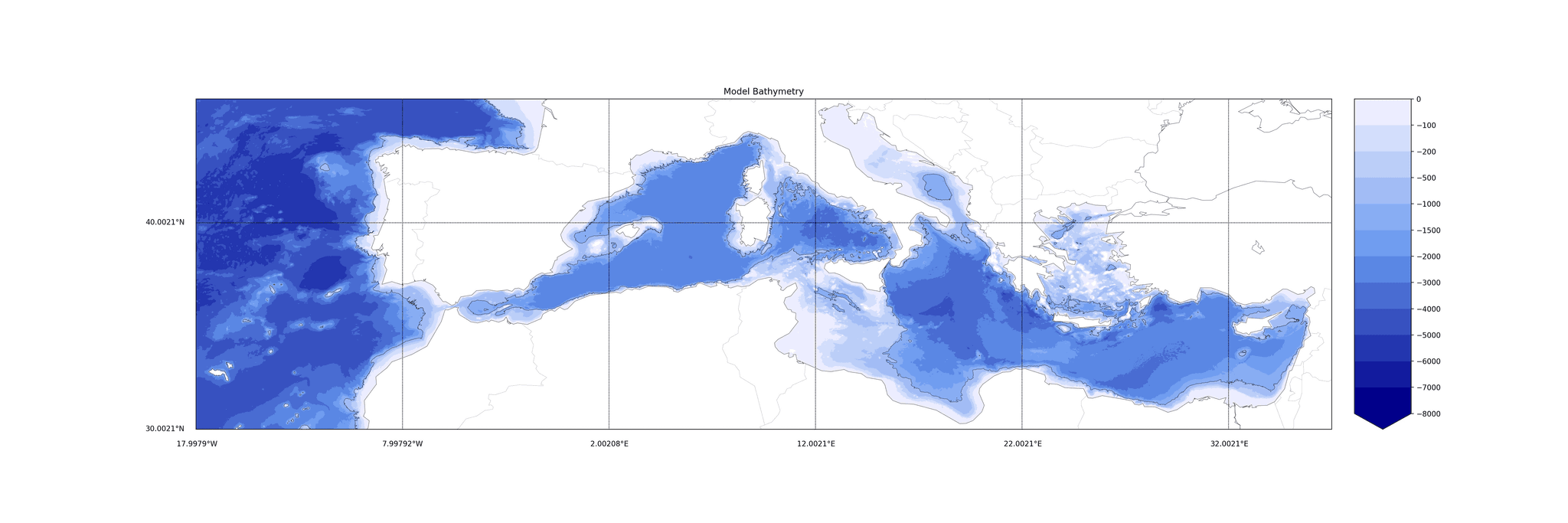
Figure 1. Model bathymetry for the MedENS
Ensemble strategy
This ensemble system explores the forecast predictability of first type (Lorenz 1975) by perturbing the initial condition used to produce the forecast. In this initial-condition ensemble forecasting experiments, the initial condition (IC) used for the forecast, which usually represents the best estimate available (i.e., analysis state) for a particular time, is perturbed by using analysis fields taken from one of the preceding 10-days. This method clearly assesses the predictability due the persistence of the flow field especially in its mesoscale components that are considered part of the chaotic components of the ocean circulation. For instance, the first ensemble member, N=1, of the ensemble forecasting the period 5-16/09/2022, is initialized with the analysis state of the 04/09/2022. Analogously, the second member, MEM#2 (MEM#N) forecasting the same 10 days is initialized with the analysis state of the 03/05/2022 (05/09/2022 minus N days). We will refer to this as an IC-shifted ensemble scheme (Figure 2). The IC-shifted ensemble scheme is used not only to produce ensemble forecasts but also to explore the forecast dependency from IC versus the atmospheric forcing. Specifically, this ensemble scheme allows us to assess the relative importance of IC and surface forcing.
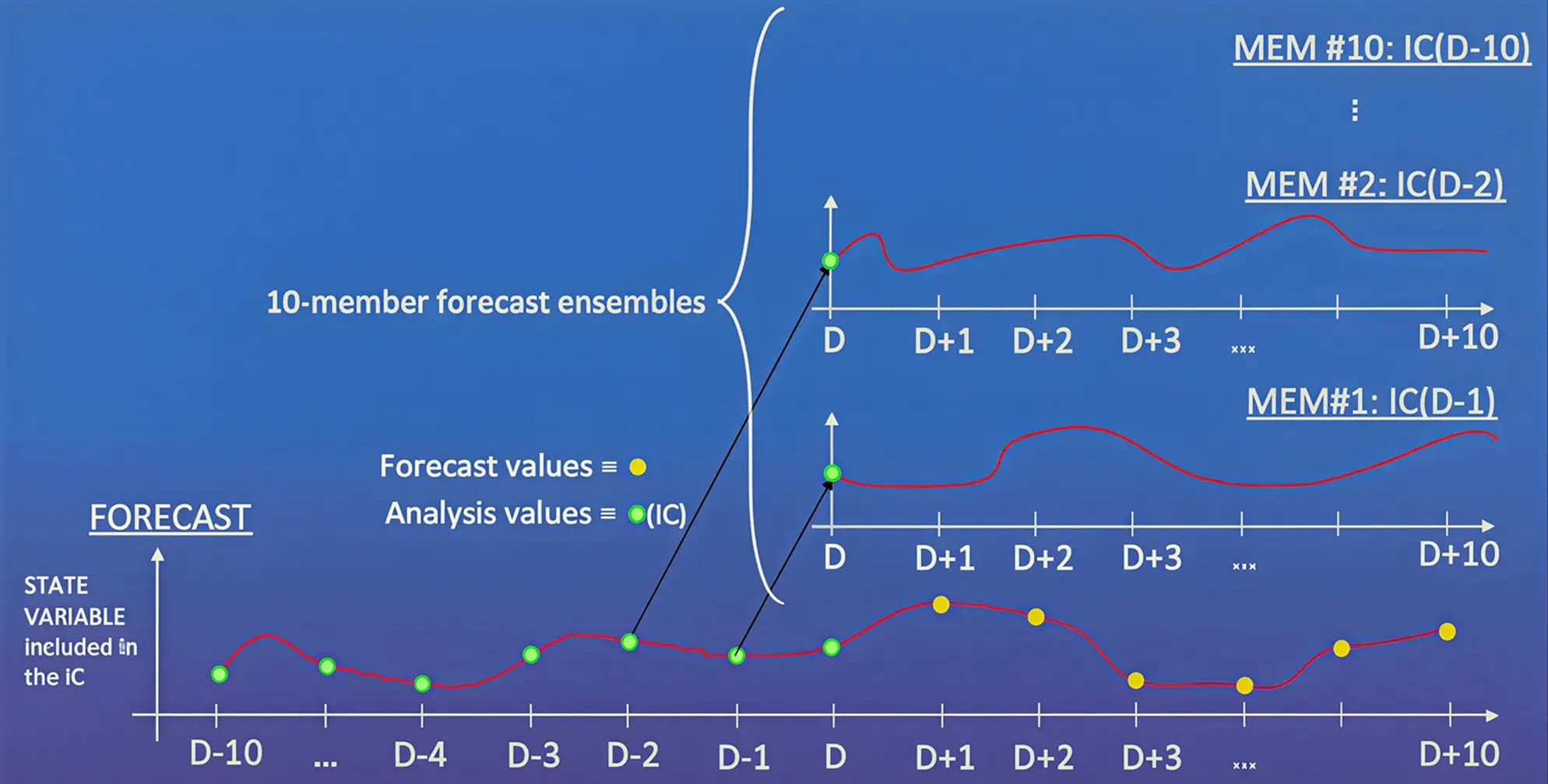
Figure 2. IC-Shifted ensemble forecasting scheme. Each ensemble member (i.e., MEM#) has been obtained using analysis estimates from previous days
The IC-shifted ensemble scheme allows us to explore the relative importance of IC and surface forcing fields; however, it produces an heterogeneous ensemble where the perturbation grows with the member number. Thus, ensemble member 1 is more likely to have smaller errors than ensemble member 2, and so on. Figure 3 shows a schematic of the production cycle for the MedENS system, which produces a 10-member ensemble every day:
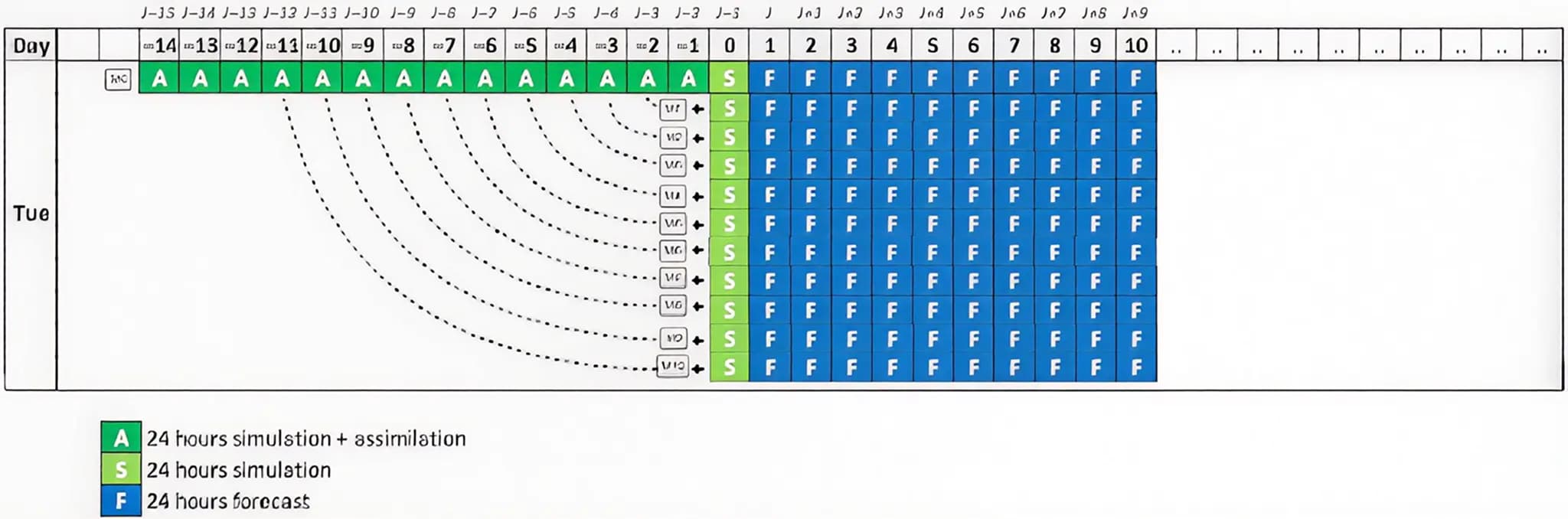
Figure 3. Production cycle for the operational ensemble forecasting system for the Mediterranean Sea, MedENS
References
- Dobricic S, Pinardi N. 2008. An oceanographic three-dimensional variational data assimilation scheme. Ocean Modell. 22: 89–105, doi: 10.1016/j.ocemod.2008.01.004.
- Lorenz , E. N. (1975). Climate predictability. In B. Bolin, et al. (Eds.), The physical basis of climate and climate modelling (Vol. 16, pp. 132–136). GARP Publication Series. Geneva: WMO.
- Madec , G., Delecluse, P., Imbard, M., Levy, C. 1998. OPA8.1 Ocean general Circulation Model reference manual. Note du Pole de modelisazion, Institut Pierre-Simon Laplace (IPSL), France, 11.
- Maderich , V.; Ilyin, Y.; Lemeshko, E. Seasonal and interannual variability of the water exchange in the Turkish Straits System estimated by modelling. Mediterr. Mar. Sci. 2015, [S.l.], v. 16, n. 2, p. 444-459, ISSN 1791-6763,doi: http://dx.doi.org/10.12681/mms.1103.
- Tonani , M., Pinardi, N., Fratianni, C., Pistoia, J., Dobricic, S., Pensieri, S., de Alfonso, M., and Nittis, K.: Mediterranean Forecasting System: forecast and analysis assessment through skill scores, Ocean Sci., 5, 649–660,doi: https://doi.org/10.5194/os-5-649-2009., 2009.